Hướng dẫn Server training
Server Training Manual: What to Include and How to Train in 5 Days
Colin, The Quiet Concierge ·
Bài viết bằng tiếng Anh.
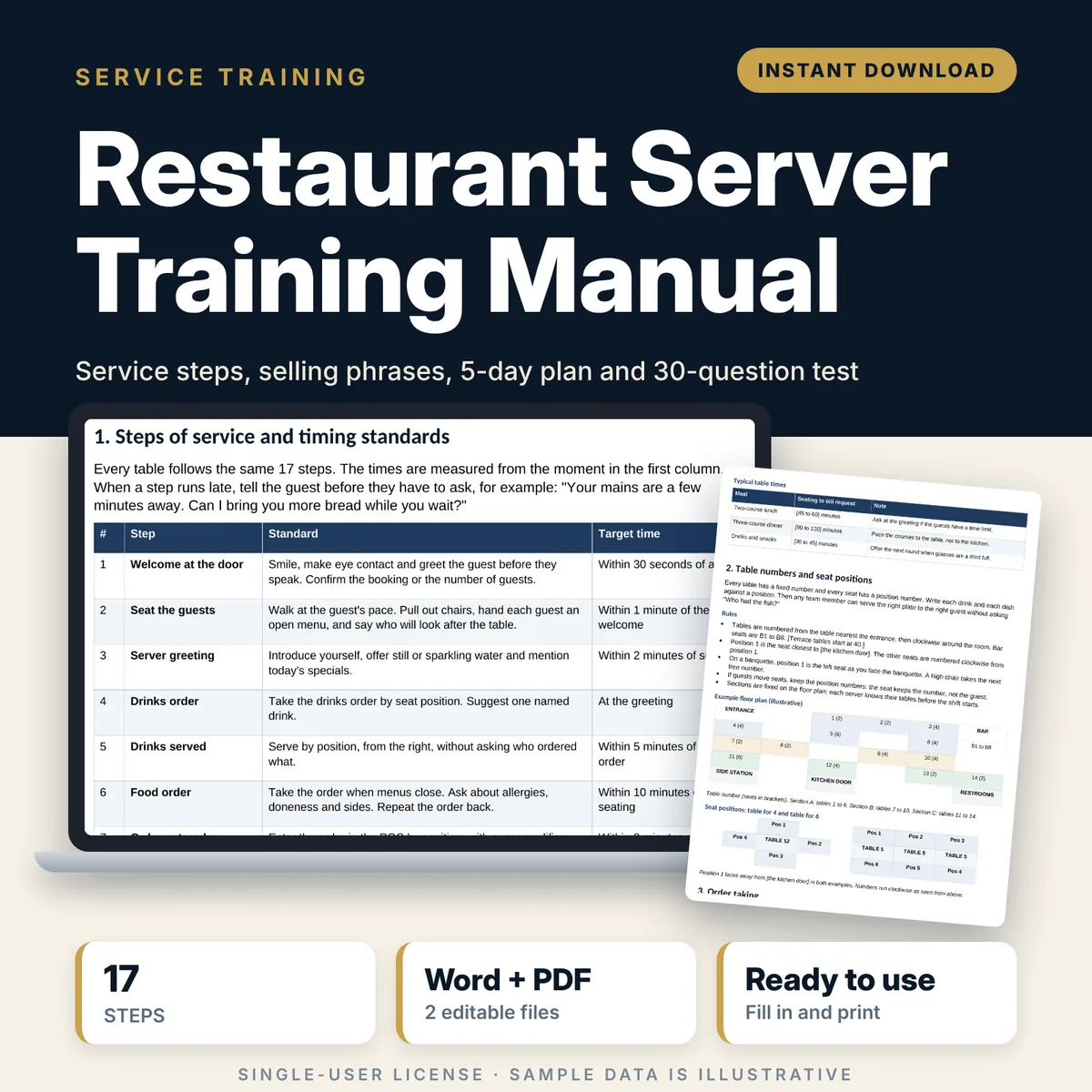
A good server training manual does one job: it makes every new server work the same way, from the first greeting to the end-of-shift list. Most manuals fail because they are long, vague or never used. This guide shows what to put in a server training manual, how to lay it out, and how to run a 5-day plan that ends with a test. You can build it yourself from this page. If you want a PDF to print, you will also find the format that works best below.
What a server training manual must contain
Keep the manual short enough that a new server reads it before the first shift. Aim for 10 to 15 pages. Cover these sections:
- Steps of service, from welcome to farewell, each with a standard and a target time.
- Table numbers and seat positions, so everyone calls the same seat the same number.
- Order taking: the steps, abbreviations, POS rules and the calls between floor and kitchen.
- Menu knowledge: what a server must know about every dish.
- Suggestive selling: what to say and when.
- Carrying and clearing: plates, trays, safety.
- Beverage basics: glass, temperature, pour, wine service.
- Complaints: a simple method and escalation rules.
- End-of-shift duties.
- A 5-day plan, a sign-off sheet and a test.
If a rule is not written down, each trainer will teach a different version of it. Write the rule, then train to it.
Write steps of service with a time for each
Break the table visit into steps. A typical list runs from greeting, water and menus, drinks, order, food delivery, check-backs, clearing, dessert and bill, to farewell. For each step write two things: the standard (what the guest sees) and a target time.
Example (replace with your own standards):
| Step | Standard | Target time |
|---|---|---|
| Greeting | Acknowledge the guest, then welcome at the table | [1 minute] |
| Drinks order | Offer water and a first drink | [3 minutes after seating] |
| Check-back | Ask once the first bites are eaten | [2 minutes after food] |
| Bill | Bring it when asked or at a natural pause | [within 2 minutes of request] |
The numbers above are examples. Set your own to suit your concept, your kitchen speed and your guests. A fast casual place and a tasting-menu room will not share the same times.
Give seats and tables a system
Most service errors come from food reaching the wrong person. Fix this with simple rules:
- Number the tables on a floor plan and give each server a section.
- Choose one reference point for seat 1, such as the seat nearest the entrance or the one facing the wall, and use it for every table.
- Number seats clockwise from there.
- Write the seat number on every order.
- Draw seat diagrams for tables of 4 and 6 and put them in the manual.
Teach the menu with short drills
Do not hand over the menu and hope. Use short daily drills of five to ten minutes before service:
- Name the dish and its main ingredients.
- List the allergens.
- Describe it in one sentence a guest would understand.
- State the cooking time and the usual side.
- Name the drink that suits it.
Make a dish knowledge card for each item with the same fields every time. Add a doneness guide for steak, so “medium” means the same thing to the server and the cook. Rotate a weekly plan so every section of the menu is covered.
Handle complaints with a method
Give servers a method they can remember under pressure. A common one is: Listen, Apologise, Solve, Thank. Then add three rules:
- Say what the server may fix alone, such as remaking a dish.
- Say what must go to a manager, such as a safety issue or a guest who stays upset.
- Record every complaint with the date, table, dish, issue, action and who handled it.
For a deeper look at authority levels and logs, see Hotel Guest Complaint Handling: Authority Levels, Complaint Logs and Service Recovery. The same ideas apply on a restaurant floor.
Run a 5-day training plan
Give the written sections to the new server before the first shift, then train on the floor.
- Day 1: Observe a trained server. Learn the floor plan, table numbers and steps of service.
- Day 2: Take orders with a trainer at your side. Practise abbreviations, POS and kitchen calls.
- Day 3: Run two tables alone. Practise carrying, clearing and drinks.
- Day 4: Run a half section. Practise selling phrases and complaint handling.
- Day 5: Run a full section, finish the end-of-shift list and take the test.
Set a practice target for each day, such as “takes five orders with no seat errors”. Sign off the day only when the target is met. If it is missed, repeat the day. A sign-off sheet with a date and signature for each skill gives you proof that training happened.
Test what was learned
End with a written test of about 30 questions. Draw questions from every section: seat numbers, steps of service, allergens, drink pours, the complaint method. Write an answer key that names the section where each answer is taught. When a server misses a question, you know exactly which page to review with them.
Check local rules
Alcohol service, food safety and employment rules differ by place. Verify local requirements before you finalise any limit or procedure in your manual. If you are also preparing a new venue, the Restaurant Opening Checklist: From Lease to Opening Night helps you plan the wider launch.
Templates
If you would rather start from a finished file than a blank page, the Restaurant Server Training Manual is built for this. Its tagline: train a new server to run a section in five days, with timings, scripts and a test. It is an editable server training manual with 17 steps of service with times, seat positions, selling phrases, complaints, a 5-day plan and a 30-question test.
It comes as a Word file (.docx) and a print-ready PDF, 13 A4 pages in 12 sections, delivered as an instant digital download. Inside:
- 17 steps of service with a standard and target time for each, plus typical table times for 3 meal types.
- Table numbers and seat positions: 5 rules, an example floor plan with 14 tables in 3 sections, and seat diagrams for tables of 4 and 6.
- Order taking: 5 steps, 12 order abbreviations, POS rules and 8 floor and kitchen calls.
- 7 menu drills, a weekly drill plan, a steak doneness guide and a dish knowledge card with 8 fields.
- 5 selling principles and 20 phrases.
- Carrying and clearing, beverage basics, the LAST complaint method with 9 common complaints and a complaint record, and a 17-point end-of-shift checklist.
- A 5-day plan with a 12-skill sign-off and a 30-question test with a separate answer key.
Values in [brackets] let you set your own house standards. Target times, pour sizes and limits are examples. It suits casual restaurants too: adjust the times and drop steps you do not use. It is a single-user license. It is also part of the Ultimate Hospitality Library and the All-Access Hospitality Template Library. To see the style of our files first, try the free hotel checklist sample.
Muốn xem định dạng trước khi mua? Tải bộ checklist khách sạn miễn phí