Hướng dẫn barista training
Barista Training: A Two-Week Plan for Managers Who Need Results
Colin, The Quiet Concierge ·
Bài viết bằng tiếng Anh.
Good barista training is not a long list of drinks to memorise. It is a short, written plan that teaches a new person the same things in the same order, checks each skill, and tells you when they are ready to work alone. This guide gives you a two-week plan, a scoring method, a sign-off checklist and a simple way to see what each cup costs. You can use it today with a pen and a spreadsheet.
Before day one: set up the basics
New baristas learn faster when the bar is ready for them. Do these things before they arrive:
- Write down your drink standards: cup size, shot count, milk type, and how each drink should look and taste.
- Choose one trainer for the whole two weeks. Changing trainers mid-way creates mixed messages.
- Block the training sessions in the rota so the trainee is not pulled onto the floor.
- Print your opening and closing checklists so the trainee can follow them from the first day.
- Prepare a simple scorecard with a pass mark for each skill.
A note on the other phrase people search for, “model trains equipment for baristas”: this guide is about training people to work on a coffee bar. It is not about toy trains. If you want equipment guidance, the maintenance and calibration sections below cover the bar equipment a trainee must learn to use and care for.
The two-week plan
Ten training days work well for most cafes. Keep sessions short, around one to two hours of focused teaching, then let the trainee practise on real service.
Week one: foundations
| Day | Focus | Checkpoint |
|---|---|---|
| 1 | Bar tour, hygiene, opening and closing routine | Can open the bar using the checklist |
| 2 | Grinder, dosing and espresso basics | Pulls a shot to your target time and weight |
| 3 | Dialling in: adjusting grind for taste | Explains why a shot runs fast or slow |
| 4 | Milk steaming: texture and temperature | Steams milk without large bubbles |
| 5 | Core drinks: espresso, americano, flat white, latte | Makes each drink to your standard |
Week two: speed and service
| Day | Focus | Checkpoint |
|---|---|---|
| 6 | Remaining menu, syrups and specials | Makes the full menu from the spec sheet |
| 7 | Customer service and taking orders | Greets, repeats the order and handles a complaint |
| 8 | Working in sequence: several orders at once | Handles a busy ten minutes with a trainer beside them |
| 9 | Cleaning routines and waste control | Completes closing checklist without prompts |
| 10 | Practical assessment and short quiz | Meets the pass mark on the scorecard |
Do not skip the checkpoint. If a trainee misses it, repeat the session the next day rather than moving on.
Teach the three core skills in order
1. Espresso
Teach one variable at a time. Set the dose, then the yield, then the time. Let the trainee change only the grind size and taste the result. Ask them to describe what they taste: sour and thin usually means the shot ran too fast, bitter and harsh often means too slow. Have them record each dial-in shot in a log so they see the pattern.
2. Milk
Milk is where most new baristas struggle. Practise with the same jug and the same volume until the result is consistent. Check three things: no visible large bubbles, a glossy surface, and a temperature you have set in your standards. Practising with cheap milk or water and a little soap is not needed; simply use real milk and accept the waste during training, then record it.
3. Service
Technical skill is only half the job. Teach the trainee to greet, confirm the order, hand over the drink and keep the bar tidy. Role-play one difficult customer so the first real one is not a surprise.
Score the trainee and sign them off
Use a simple scale for each skill: 0 not yet, 1 needs help, 2 works alone with errors, 3 meets standard. Score every skill at the end of each week.
Sign-off checklist before solo shifts:
- Opens and closes the bar from the checklist
- Pulls espresso to standard three times in a row
- Steams milk to standard on both flat white and latte
- Makes every menu drink from the spec without help
- Cleans the machine and grinder correctly
- Logs waste honestly
- Handles a complaint calmly
- Passes the written quiz
If any box is empty, extend training. A short delay costs less than a week of poor drinks and unhappy guests.
Know what each cup costs
Training should include cost awareness, because waste and over-dosing come from habits. A basic cost per cup adds up what goes into the drink and divides by one cup.
Worked example (these numbers are examples, replace them with your own):
| Item | Example cost |
|---|---|
| Coffee, 18 g | 0.30 |
| Milk, 200 ml | 0.16 |
| Cup, lid and sleeve | 0.20 |
| Total cost per cup | 0.66 |
| Menu price before tax | 3.00 |
| Cost percentage | 22% |
The cost percentage is cost divided by menu price, so 0.66 divided by 3.00 gives 22%. Compare it with your own target. For the same method applied to a whole kitchen, read How to Calculate Food Cost Percentage: Formula, Worked Example and Targets.
Keep the standards alive after training
Training ends, but standards drift. Do these weekly:
- Review the dial-in log and the waste log.
- Run a quality check on three random drinks.
- Check the grinder calibration and temperature records.
- Do a deeper clean of the machine.
- Re-score one skill for each barista.
If you want a taste of the checklist format first, download the free hotel checklist sample and adapt the layout for your bar.
Templates
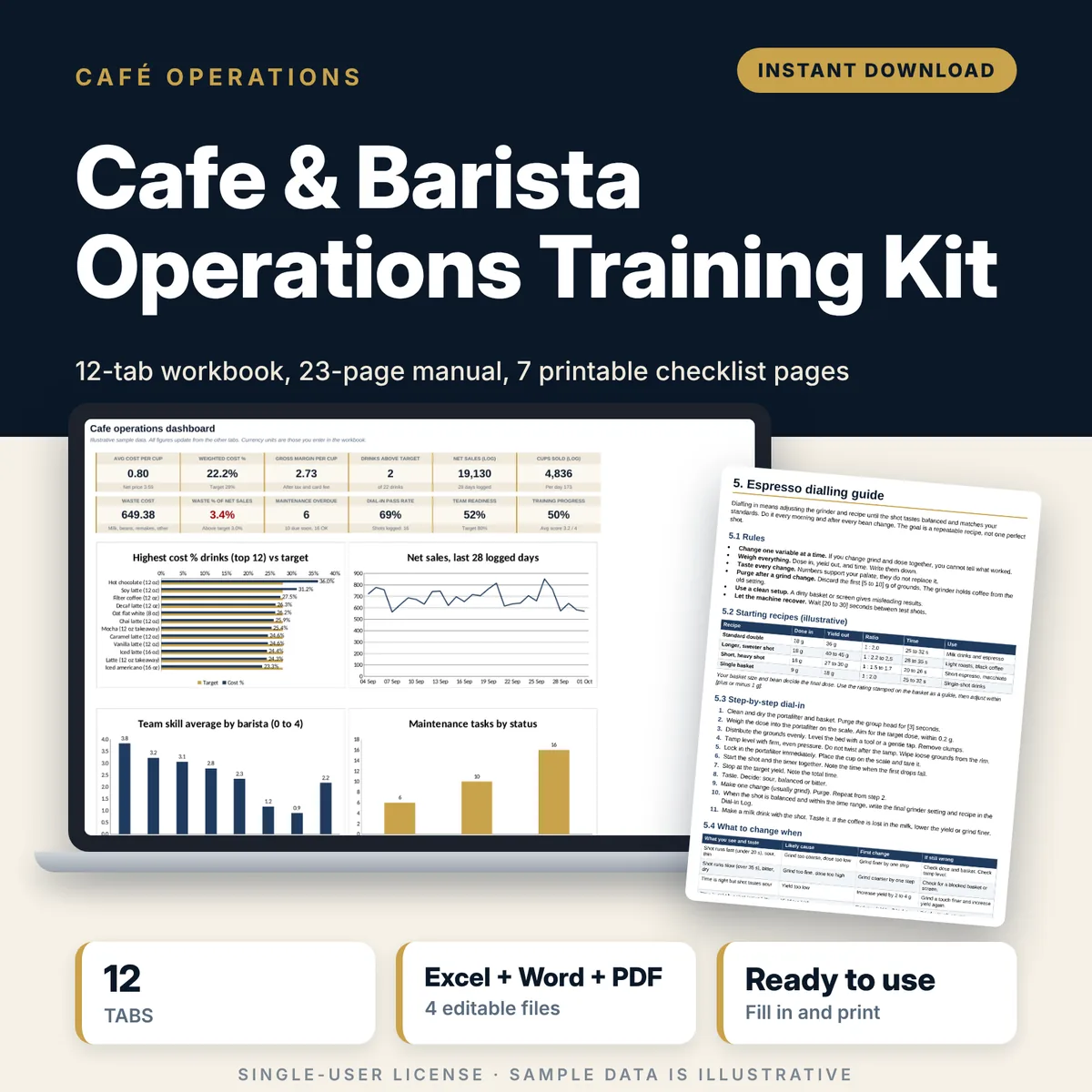
If you would rather not build all of this from scratch, the Cafe & Barista Operations Training Kit gives you a written way to train new staff and a simple way to see what each cup costs. Its tagline is: train baristas, cost every cup and run the bar with checklists you can print today.
The kit includes:
- A cafe cost per cup workbook in Excel with 12 tabs, covering ingredients, drink specs, cost per cup, a sales and waste log, a dial-in log, equipment maintenance, a skills matrix and a training tracker.
- A 23-page barista training manual in Word with a two-week plan of 10 training days and 20 sessions, plus guides for espresso dialling and milk texturing, a practical scorecard and a 20-question quiz with answers.
- Printable A4 checklists in PDF and Word: opening, closing, quality check, grinder calibration log, temperature log and weekly deep clean.
All files are editable, and the sample prices, scores and results are illustrative, so you replace them with your own. It is a working tool, not professional advice, so verify local requirements for tax, food safety, hygiene and employment. It is also part of the Ultimate Hospitality Library and the All-Access Hospitality Template Library.
Muốn xem định dạng trước khi mua? Tải bộ checklist khách sạn miễn phí