Guides Group Sales
Hotel Sales Kit: What to Include for Group and MICE Business
By Colin, The Quiet Concierge ·
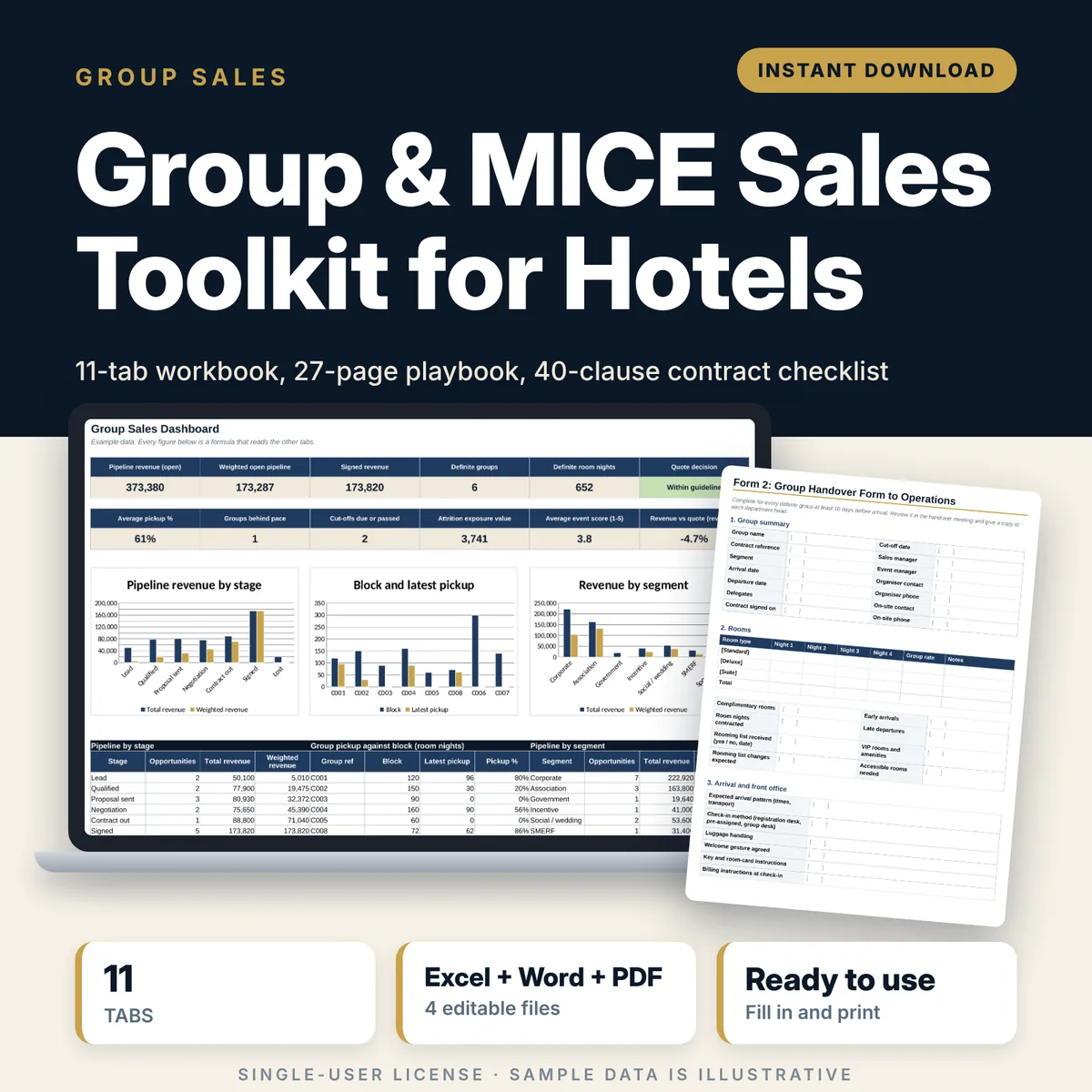
A hotel sales kit is the set of tools a salesperson uses to answer an enquiry, price it, send a proposal, sign a contract and follow the group through to the final bill. Most hotels already have these pieces, but they sit in different spreadsheets, old Word files and email threads. This guide sets out what a working kit contains, how the parts connect, and how to build the pricing core this week.
What a hotel sales kit needs to contain
A kit is useful only if every piece supports the next one. Check your own against this list.
- A qualification method, so you know which enquiries deserve a full proposal.
- A quote calculator covering rooms, food and beverage, meeting rooms and AV.
- A displacement check against the transient business the group would replace.
- RFP response and proposal templates with consistent wording.
- A site inspection plan.
- A negotiation guide with agreed concessions and who can approve them.
- A contract clause checklist, reviewed by your own counsel.
- A pickup tracker and rooming list.
- A handover form to operations and a post-event review.
If two or three of these are missing, that is where deals leak: inconsistent quotes, missed cut-off dates or groups that quietly under-deliver.
Step 1: Qualify before you quote
Score each enquiry on a short grid so the team spends time where it pays. Useful criteria:
- Dates fit your demand pattern.
- Room nights are enough to justify the work.
- Food, beverage and meeting space add revenue beyond rooms.
- The buyer has authority and a decision date.
- The group has a booking history you can ask about.
Give each criterion a score from 1 to 5 and set a threshold below which you send a short reply instead of a full proposal.
Step 2: Price the group from every revenue line
A group quote should be built up, not guessed. Enter rooms by night and room type, then food and beverage, meeting rooms and AV. Add comps, service charge, tax and deposits, and finish with a profit check. Treat tax, service charge and deposit terms as inputs that you verify locally.
Step 3: Test the quote against displacement
A group rate looks good until you compare it with the transient guests you would turn away. Work night by night.
Worked example
All figures below are an example. Replace them with your own.
| Night | Rooms for group | Transient rate you would expect | Transient rooms displaced |
|---|---|---|---|
| Monday | 40 | 120 | 30 |
| Tuesday | 50 | 130 | 40 |
| Wednesday | 40 | 110 | 20 |
Displaced transient revenue in this example: 30 x 120 + 40 x 130 + 20 x 110 = 3,600 + 5,200 + 2,200 = 11,000.
Group rooms in total: 130. If the group also brings 6,000 of net food, beverage and meeting revenue, you need the room revenue to cover the rest of the displaced amount. Break-even room rate is roughly (11,000 minus 6,000) divided by 130, about 38.5 per room night, before costs and the value of the extra revenue lines. Add your own cost per occupied room and a minimum margin to set a real floor rate.
The point is the method: know your floor rate before you open negotiation.
Step 4: Send a consistent response
Use one RFP response structure and a small set of proposal templates, for example corporate meeting, residential conference and social event. Keep the cover letter short, state the rate and what it includes, and give a clear reply date. Consistent wording also makes it easier for a new salesperson to work from day one.
Step 5: Contract with a checklist
Before any contract goes out, run it through a clause checklist covering items such as cut-off dates, deposits, attrition and cancellation terms. A checklist is a general aid. Have counsel review your contracts and verify local requirements.
Step 6: Track pickup and review results
After signing, record the group and update pickup at fixed checkpoints against a target pace. Compare projected final rooms with the contracted block to see attrition exposure early. When the event ends, compare actual with quoted revenue. Those results feed your next quote.
Quick weekly routine:
- Update pickup on every active group.
- Check upcoming cut-off dates.
- Review next actions in the pipeline.
- Hand signed groups to operations with a written form.
If you are also planning budgets, see How to Build a Hotel Budget: A Step-by-Step Method for General Managers. For operational checklists, try the free hotel checklist sample.
Templates
The Group & MICE Sales Toolkit for Hotels lets you quote, contract and track group business with one workbook and one playbook. It is for group sales managers, MICE sales executives and banquet sales teams at hotels, conference venues and event spaces.
- An Excel group quote and pickup tracker with 11 tabs, including Quote Calculator, Displacement, Contracts, Pickup Tracker and Post-Event Review.
- A 27-page sales playbook with RFP and proposal templates, a pricing and displacement guide, a site inspection guide, a negotiation guide and 8 email templates.
- A 40-clause contract checklist (generic, verify with counsel).
- Printable forms, including a site inspection checklist, group handover form and post-event review.
Formats are XLSX, DOCX and PDF, with an A4 layout and an editable currency. Sample names, rates and figures are illustrative, so replace them with your own. It is also part of the Ultimate Hospitality Library and the All-Access Hospitality Template Library.
Want to see the format before you buy? Download the free hotel checklist sample